
What Edge City has learned about building voluntary interdependence at scale (so far)
Timour Kosters


This article was developed in collaboration with Lovisa Björna who made significant contributions to its drafting and structure.
Across the world, communities are forming online and gathering in physical space (pop-up villages, co-living experiments, network schools, temporary cities), testing new ways of living and organizing together. A growing number of these communities are asking a version of the same question: how does the early experience of “finding one’s people” develop into stable structures with shared responsibilities and long-term commitment?
The Network Nations framework offers one promising way to think about this. Grounded in commons-based governance, non-territorial coordination, and integration with existing institutions, it provides a vocabulary for how distributed communities might develop genuine sovereignty over time without importing the coercive mechanisms of the state or reducing everything to market dynamics. Within this framework, the concept of entanglement, the intentional weaving of layered, voluntary ties between people, places, and institutions, has emerged as a particularly useful idea. As laid out by Primavera De Filippi, entanglement gives us a way to think about how communities build interdependence deliberately, across multiple dimensions, in a sequence that earns each successive layer of commitment.
At Edge City, we have been trying to do exactly this. The design space is still wide open, and the discussions are early. This article is intended as a contribution to that broader exploration, using Edge City as a case study to make an abstract concept more tangible, anchoring it in the lived reality of a community attempting to build voluntary interdependence in practice. What follows is less a polished framework than a set of grounded observations. As Edge City grows, it makes sense to document what we have learned and to offer those lessons back to the broader conversation on Network Sovereignty and Network Nations.
Entanglement gives us four layers to work with (social, cultural, economic, and structural) each building on the previous one. The logic is sequential: you cannot build durable economic cooperation between people who do not yet share a cultural identity, and you cannot build cultural identity between people who have not yet formed real social bonds. What follows traces that sequence through what we have seen at Edge City so far.
I. Social Entanglement
The first layer of entanglement is social: the personal bonds, shared experiences, and mutual trust that form between individuals. The default assumption in most community projects is that social bonds emerge naturally from proximity: bring interesting people together, provide a shared context, and trust that relationships will form. This assumption is not entirely wrong, but it is insufficient. Emergence produces connections, though it does not reliably produce interdependence. Entanglement is the proactive attempt at actually adding interdependencies, rather than observing them or hoping they form.
There is something worth saying here about serendipity. A lot of community design fixates on programming, filling every hour, curating every interaction. What we have found is that the most meaningful connections tend to happen in the gaps: the unstructured dinners, the late-night conversations that weren’t on anyone’s schedule, the chance encounters that come from simply being in the same place long enough. The job of the organizer is to create the conditions for serendipity rather than replace it with choreography.
At Edge City, we treat community as an output rather than an input. It is not something that exists prior to the program and simply needs a venue. Participants arrive as individuals and learn that they have permission to create the thing they are stepping into. All of our events are co-created: people co-organize workshops, present startups at demo days, run residencies. The act of creating the container is recursive and creates a very pleasant feedback loop: people build the experience they are having, feel good about participating, develop a sense of ownership over what they have made, and want to invite others into it.
The first Edge City drew from a wide variety of people: our pre-community from the Zuzalu days, extended networks, and people who simply responded to what was effectively a bat signal. Values-forward messaging, very lightweight, a loose articulation of what we were into and what was going to happen. The community self-selected and then began to create itself. What matters is the lightness of touch. If these conditions are overengineered, if participants can see the scaffolding too clearly, the experience begins to feel manufactured rather than meaningful. Set the conditions, give people permission, and then step back.
II. Cultural Entanglement
Once social bonds exist, the question becomes what holds them together across time and distance. This is the cultural layer: a shared identity that emerges from those relationships, a sense that there is a “we” beyond any individual interaction.
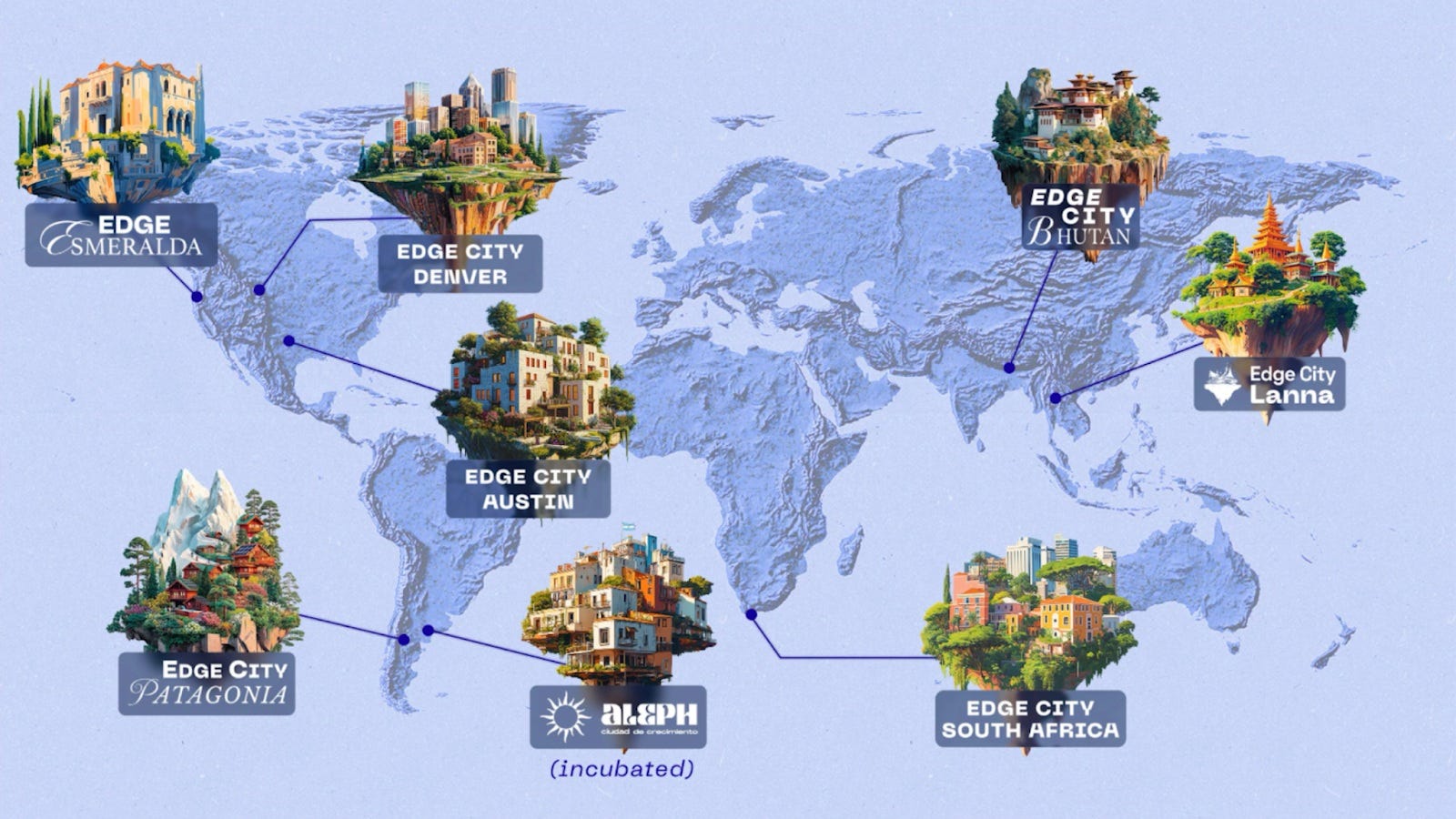
Edge City does not have a fixed address. Our events have taken place across continents (Patagonia, South-East Asia, California, Europe) and our community is even more dispersed than our venues. With over 12,000 people having come through an Edge City event, no single participant has met more than one or two hundred of them. And yet something has started to happen that we did not entirely design. People who have spent significant time at these events, some having accumulated over sixty days across multiple gatherings, have begun developing identity bonds to the broader concept of Edge City itself rather than to a specific place or cohort.
This is the phenomenon Benedict Anderson described as imagined communities: people who will never meet their fellow members face to face nonetheless feel themselves part of a shared project, willing to spend energy providing for it. We do not yet have the depth of commitment that nation states command, but the seed is there: a sense of belonging that exceeds any individual’s direct social network within the community.
What makes this possible is accumulated time and intensity. A typical conference gives you three days of light contact. Our events give people weeks of living, working, and building alongside each other. The connections that form are the kind that come from shared meals, shared problems, shared late nights, and they are qualitatively different from networking connections. When people leave, they carry something with them: a set of references, identity markers, a sense of what Edge City is and what it values, that persists after the physical gathering ends.
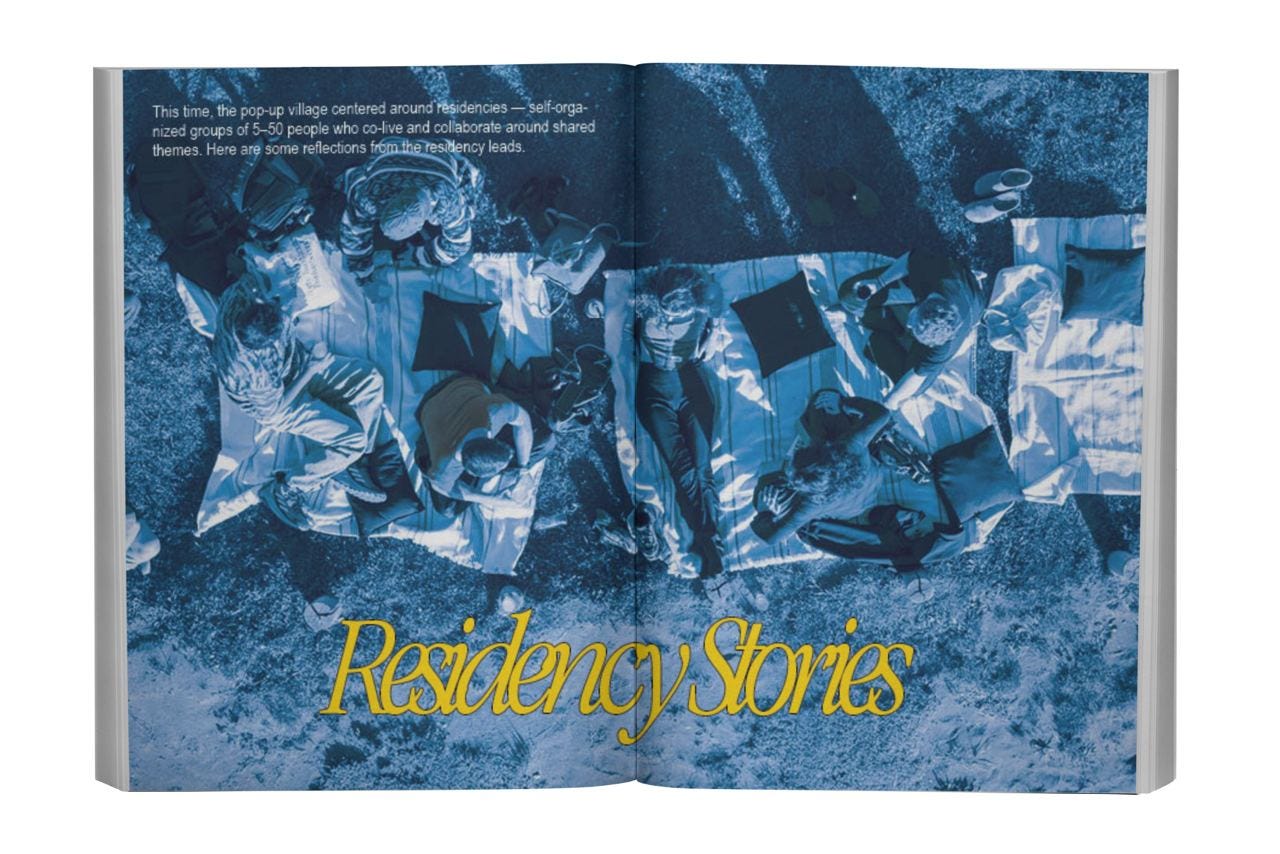
The structural problem is how to allow a community to grow without dissolving the intimacy that sustains it. Our working approach has been fractal organization. The Patagonia gathering was designed as a collection of roughly a dozen residencies, each a thirty-person pop-up village with its own focus areas and social norms, but integrated into a wider networked environment. Intimacy forms within the residency itself, while belonging extends across the broader community. Participants who have moved through multiple residencies across continents begin to carry a cultural identity that no single event could produce. This traveling residue of shared experience is what cultural entanglement looks like at Edge.
III. Economic Entanglement
Once cultural identity exists, the question becomes whether people will put material stake into the thing they belong to, something with real financial weight beyond time and attention. This is the economic layer: shared resources, shared ownership, shared risk that binds participants to the collective beyond sentiment. It is also, for a community at our stage, the layer where the distance between aspiration and reality is most honestly felt.
The primary economic relationship at Edge City is still transactional. Someone visits our platform, adds a ticket to a shopping cart, purchases it, and shows up. That is a user relationship, and there is no sense in describing it as anything else. We are still at the stage of trying to entangle people into the co-creation of the experience, not the co-ownership of the institution.
There is an interesting informal economy already operating within Edge City. People put hours into using each other’s products, giving feedback, hosting events for the broader community, often with no direct financial benefit. The social capital of being seen to contribute to the collective is, at our current scale, more powerful than any formal economic mechanism we could introduce.
My own experience taught me something that has stayed with me: owning a piece of the whole changes your relationship to the work entirely. When you have equity in the broader entity, when its success is materially your success, the motivation to contribute shifts from social goodwill to something more structurally durable. One could imagine, in time, a shared pool of equity in startups incubated within the community, or some form of token-based ownership. Early DAOs attempted similar things and the concept is strong. But introducing economic entanglement before the social and cultural layers are solid would repeat a well-documented mistake. Tokens, treasuries, and equity structures introduced prematurely can distort a community rather than strengthen it. The economic layer remains, for now, a deliberately open question, because premature answers risk narrowing the design space before it has been adequately explored.
IV. Structural Entanglement
The final layer is structural: the formal rules, membership definitions, decision-making processes, and accountability mechanisms that constitute what a community actually is in institutional terms. Where economic entanglement creates shared stake, structural entanglement creates shared identity at the level of governance, the point at which participants become, in any meaningful sense, part of each other. Structural entanglement is the layer at which a community moves from being a network of aligned individuals to being an institution with its own continuity.
Edge City has not yet taken this step, which is again a deliberate choice. The community has not formally adopted a protocol of citizenship for its participants. We have the aspiration to move in the direction where people feel their identity as part of this community, where they want to participate in its governance, where they want to build their work within its context. But the infrastructure to support that aspiration does not yet exist.
What is missing is substantial. We lack an identity layer, a digital or physical marker of belonging that participants can carry with them, ideally on an open protocol that allows membership across multiple communities simultaneously. We lack a mechanism for managing shared resources. And we lack a constitutional framework that specifies what participation means: what someone is signing up for, what the community offers in return, what the boundaries and obligations are. These are all things that are required to shift from user to citizen.
Entanglement could function as a continuum: someone with no entanglement is effectively a user; the more they choose to invest (socially, culturally, economically) the more the community can trust that their decisions reflect genuine long-term commitment rather than transactional interest. Those who are deeply entangled, who have demonstrated through sustained participation that they are not going to leave at the first difficulty, could reasonably be granted more voice in governance, because their stake makes their decisions credible. This is not a novel idea in democratic theory, but applying it to a distributed, voluntary community without fixed territory raises design questions that do not yet have tested answers.
There is a final tension worth noting. Structural entanglement creates the conditions under which people work through difficulty rather than exit, but it also creates the conditions under which communities can become coercive. The goal is not to eliminate exit at all costs. Participation must remain voluntary and people must be able to decide not to come. The structural layer needs to be strong enough to hold a community through disagreement, but not so rigid that it traps people in arrangements they no longer consent to. Where that line falls is not something that can be determined in advance. It can only be discovered through the slow, iterative process of building the thing and watching what it requires.

What Practice Teaches
One thing you learn from doing this work, rather than theorizing about it, is that the interesting problems are almost never where you expect them to be. The theoretical questions (what governance model, what ownership structure, what constitutional framework) are important, but they are downstream of something much harder to see from a distance: the texture of how people actually relate to each other when the stakes are real and the rules are still being written.
The most useful insight from building Edge City is that sequencing is everything. The communities that struggle most are the ones that try to formalize too early, reaching for governance structures, token models, or constitutional frameworks before the social and cultural soil is deep enough to support them. The entanglement framework gives us a language for why this matters: each layer earns the right to the next.
We are, by honest assessment, at the beginning of this sequence. Something real has been built at the social and cultural layers: over 12,000 people who share an identity, a growing number who have accumulated genuine commitment through participation and co-creation. The economic and structural layers remain open. The identity layer, shared ownership model, and constitutional framework all remain to be built. These things will take years to define well. But the framework is clear enough to work with, and the sequencing logic is clear enough to follow.
For practitioners working at the intersection of technology and governance, the question of how distributed communities develop real sovereignty is one of the most consequential of our time. If these experiments succeed, they could meaningfully expand the political agency available to individuals and communities. But such transformations do not unfold automatically. They require sustained, patient engagement and a willingness to let the right answers emerge in their own time rather than imposing them prematurely.
The good news is that the answers are emerging. Thousands of people, across dozens of gatherings, on multiple continents, are already living inside the early layers of this experiment. The entanglement is real, and it is growing. What comes next will be built by the people who stay.
This piece draws on a conversation from Network Nations Episode 4: “Entanglement — Building Voluntary Interdependencies” (Green Pill Podcast).
Listen to the episode here:
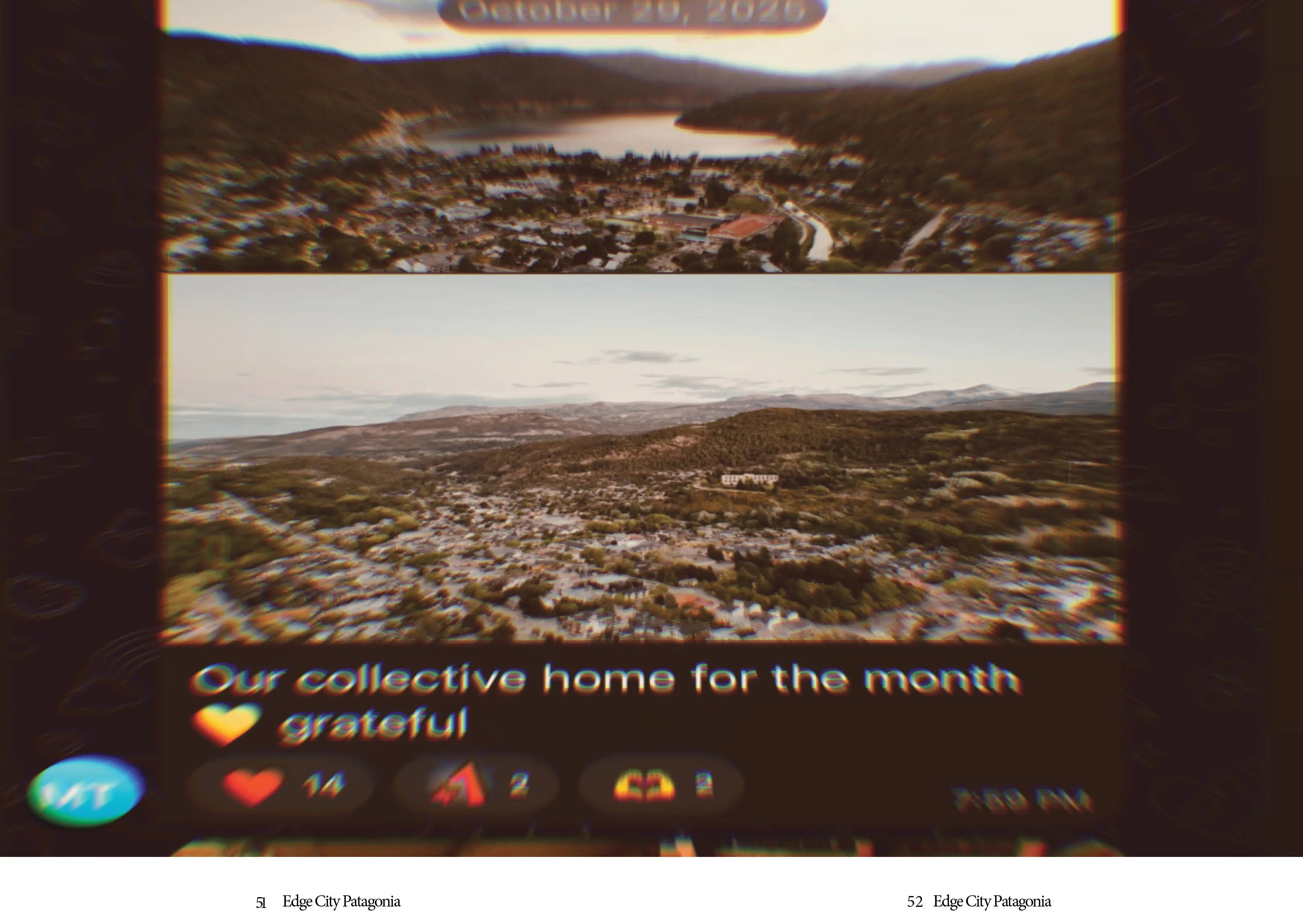
Link to Edge City Patagonia Zine.
 | A guest post by
|